



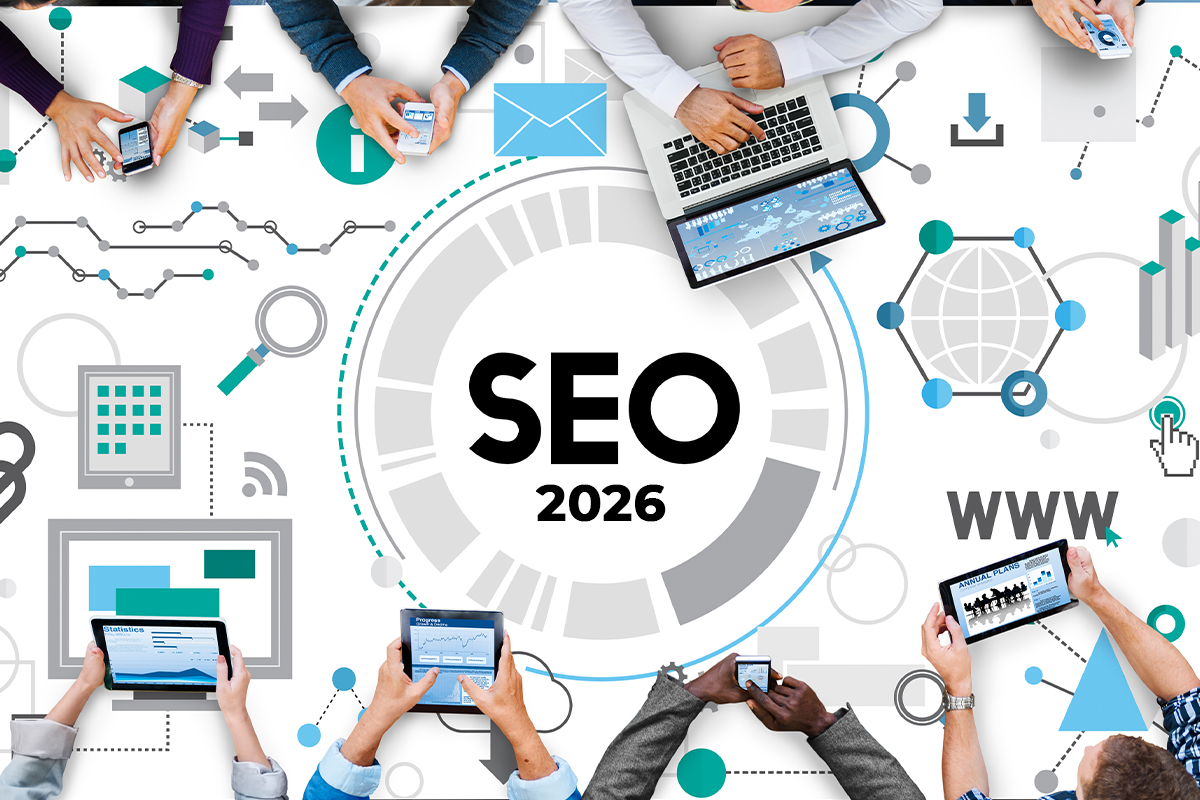
SEO in 2026 will not be about chasing algorithms, hacks, or shortcuts. It will be about alignment—alignment with user intent, content depth, experience, and trust. The websites that win will not necessarily be the ones publishing the most content, but the ones building the most reliable search experiences.
- How Search Has Evolved Leading into 2026
- Trend #1: AI-Driven Search and Advanced Content Understanding
- Trend #2: Search Intent Matching Becomes Non-Negotiable
- Trend #3: Topical Authority Becomes a Primary Ranking Differentiator
- Trend #4: UX and Engagement Signals Expand Beyond Core Web Vitals
- Trend #5: Personalised and Contextual Search Results Expand
- Trend #6: Voice and Conversational Search Mature
- Trend #7: Visual Search and Multimodal Discovery
- Trend #8: E-E-A-T Evolves into Experience-First Trust Signals
- Trend #9: Local SEO Becomes Hyper-Contextual
- Trend #10: Data-Driven and Predictive SEO
- Trend #11: Structured Data Becomes Table Stakes
- Trend #12: Privacy, Regulation, and First-Party Data Shape SEO
- How These SEO Trends Connect
- How to Prepare Your SEO Strategy for 2026
- Common SEO Trend Myths to Avoid
Search engines have matured. They no longer ask, “Does this page contain the keyword?” Instead, they ask, “Does this page deserve to be shown for this query, for this user, at this moment?”
This shift has been gradual over the past decade, but by 2026 it becomes unavoidable. SEO is no longer a siloed activity. It is tightly connected with product experience, content strategy, brand trust, and behavioural signals.

This guide breaks down the most important SEO trends shaping 2026, explains why they matter, and—most importantly—shows how to prepare your SEO strategy so you’re not reacting late.
How Search Has Evolved Leading into 2026
To understand where SEO is going, it’s important to understand where it came from.
Search started as a keyword-matching system. Pages with exact keywords ranked higher. Over time, this evolved into link-based authority models. Then came semantic search, intent matching, and behavioural analysis.


By 2026, search is no longer about individual queries. It’s about search journeys.
Users don’t search once—they search repeatedly, refining intent, comparing answers, and making decisions across sessions, devices, and formats. Search engines now evaluate whether your content supports that journey, not just whether it answers one question.
SEO in 2026 is therefore:
- Topic-based, not keyword-based
- Experience-driven, not content-volume-driven
- Trust-focused, not link-only-focused
This context shapes every trend discussed below.
Trend #1: AI-Driven Search and Advanced Content Understanding
AI is no longer just assisting search engines—it is shaping the way results are generated, summarised, and displayed.
Search engines increasingly use AI to:
- Understand nuance and context in queries
- Summarise multiple sources into overview-style results
- Evaluate content quality beyond surface-level signals
This does not mean “SEO is dead” or “content will be replaced by AI.” It means content quality thresholds are higher.
In 2026, SEO content must:
- Demonstrate clarity, depth, and completeness
- Provide original insight or structure
- Be easy for AI systems to understand and extract meaning from
Thin, repetitive, or generic content—whether human- or AI-written—will struggle. Content that is well-structured, topic-focused, and experience-driven will thrive.
Trend #2: Search Intent Matching Becomes Non-Negotiable
Search intent optimisation is not a tactic anymore—it is the foundation of SEO.
By 2026, pages that do not clearly match dominant search intent will struggle to rank, regardless of backlinks or technical strength. Search engines are increasingly confident in identifying what users expect for a query.
This means:
- Blogs will not rank for service-intent queries
- Service pages will not rank for informational queries
- Mixed-intent pages will lose stability
SEO strategies in 2026 must begin with SERP-first thinking. Before creating content, you must understand:
- What type of page Google prefers
- What depth users expect
- What action (if any) users want to take next
Intent alignment will often outperform traditional optimisation tactics.
Trend #3: Topical Authority Becomes a Primary Ranking Differentiator
Topical authority is no longer an advanced SEO concept—it is a baseline expectation.
In 2026, search engines reward websites that:
- Focus on clearly defined subject areas
- Cover topics comprehensively
- Show consistent expertise across related queries
Publishing random content across multiple niches weakens authority signals. Focused websites that deeply cover fewer topics will outperform broader sites with shallow coverage.
This is why topic clusters, pillar pages, and internal linking structures become essential—not optional.
Topical authority also shortens ranking timelines. Once authority is established, new pages rank faster because they’re supported by an existing topical ecosystem.
Trend #4: UX and Engagement Signals Expand Beyond Core Web Vitals
Page speed and Core Web Vitals were just the beginning.
By 2026, search engines evaluate holistic user experience, including:
- Ease of navigation
- Content readability
- Interaction quality
- Satisfaction signals
SEO is no longer just “technical SEO” and “content SEO.” UX and SEO are merging.
Pages that technically load fast but frustrate users will struggle. Pages that are slower but deeply satisfying may still perform well.
This pushes SEO closer to product thinking: Does this page genuinely help the user complete their task?
Trend #5: Personalised and Contextual Search Results Expand
Search results are becoming increasingly personalised based on:
- Location
- Device
- Search history
- Behavioural patterns
By 2026, two users searching the same query may see noticeably different results.
This means SEO strategies must focus less on “one ranking position” and more on visibility across contexts. Ranking well in general is important, but relevance within user segments is equally critical.
This also increases the importance of:
- Local SEO signals
- Contextual content
- Structured data
Trend #6: Voice and Conversational Search Mature
Voice search adoption continues to grow, but the real change is conversational search behaviour, not just voice devices.
Users increasingly phrase searches as natural questions:
- “What’s the best way to improve local SEO for a small business?”
- “Is Shopify good for SEO in 2026?”
Optimising for conversational patterns means:
- Writing naturally
- Structuring content around questions and answers
- Using clear, direct explanations
Featured snippets and concise answers become more valuable as conversational queries rise.
Trend #7: Visual Search and Multimodal Discovery
Search is no longer text-only.
Images, videos, and mixed media increasingly influence discovery. Users may:
- Search using images
- Discover content via video previews
- Evaluate brands visually before clicking
SEO strategies in 2026 must treat visual content as a first-class asset, not an afterthought.
This includes:
- Optimised images with contextual relevance
- Video content aligned with search intent
- Visual consistency and clarity
Visual signals support trust and engagement, which indirectly influence SEO performance.
Trend #8: E-E-A-T Evolves into Experience-First Trust Signals
Experience becomes the most critical part of E-E-A-T.
Search engines increasingly reward content that demonstrates:
- First-hand knowledge
- Practical understanding
- Real-world application
Generic explanations without demonstrated experience lose credibility.
By 2026, trust is built through:
- Depth and accuracy
- Consistent topic focus
- Transparent author or brand signals
- User engagement and satisfaction
This is especially important in competitive or sensitive niches.
Trend #9: Local SEO Becomes Hyper-Contextual
Local SEO continues to grow, but becomes more context-aware.
Search engines consider:
- Proximity
- Relevance
- Real-world engagement signals
- Review sentiment and recency
Generic local pages will struggle. Businesses must create location-aware, experience-driven content that genuinely reflects local intent.
Local SEO in 2026 is about being the best answer for that place, not just the closest one.
Trend #10: Data-Driven and Predictive SEO
SEO analytics are shifting from reactive reporting to predictive insights.
By 2026, successful SEO teams use data to:
- Forecast ranking opportunities
- Identify content gaps early
- Measure topic footprint instead of isolated keywords
This doesn’t replace human judgment—it enhances it. Data informs strategy, but strategic thinking still determines execution.
Trend #11: Structured Data Becomes Table Stakes
Structured data is no longer optional.
Search engines rely on structured signals to:
- Understand content relationships
- Display rich results
- Enhance CTR and visibility
In 2026, structured data supports discoverability across:
- Traditional search
- AI-generated summaries
- Visual and voice interfaces
Websites that ignore structured data miss out on visibility opportunities even if their content is strong.
Trend #12: Privacy, Regulation, and First-Party Data Shape SEO
Privacy changes continue to limit traditional tracking. As third-party data disappears, SEO becomes one of the most reliable acquisition channels.
This increases the value of:
- First-party data
- On-site engagement metrics
- Search behaviour insights
SEO strategies must adapt to a world with less tracking but more emphasis on content relevance and experience quality.
How These SEO Trends Connect
These trends are not isolated.
AI enhances intent matching.
Intent matching reinforces topical authority.
Topical authority improves engagement.
Engagement supports trust.
Trust improves visibility.
SEO in 2026 is a connected system, not a checklist.
How to Prepare Your SEO Strategy for 2026
To future-proof SEO:
- Build around topics, not keywords
- Optimise for intent before optimisation tactics
- Focus on content depth and experience
- Strengthen UX and engagement
- Use structured data consistently
- Embrace AI as an assistant, not a shortcut
- Measure success beyond rankings
Websites that do this won’t just survive 2026—they’ll dominate it.
Common SEO Trend Myths to Avoid
- “AI content alone will rank”
- “Backlinks no longer matter”
- “Long content always wins”
- “SEO is dying”
SEO is not dying. Shortcut SEO is dying.
SEO in 2026 rewards clarity over cleverness, depth over volume, and experience over optimisation tricks.
The websites that succeed will be the ones that genuinely understand their audience, commit to topics, and design content as a search experience, not just a ranking attempt.
If you build for users first—and structure for search intelligently—SEO becomes more stable, more predictable, and more powerful than ever.